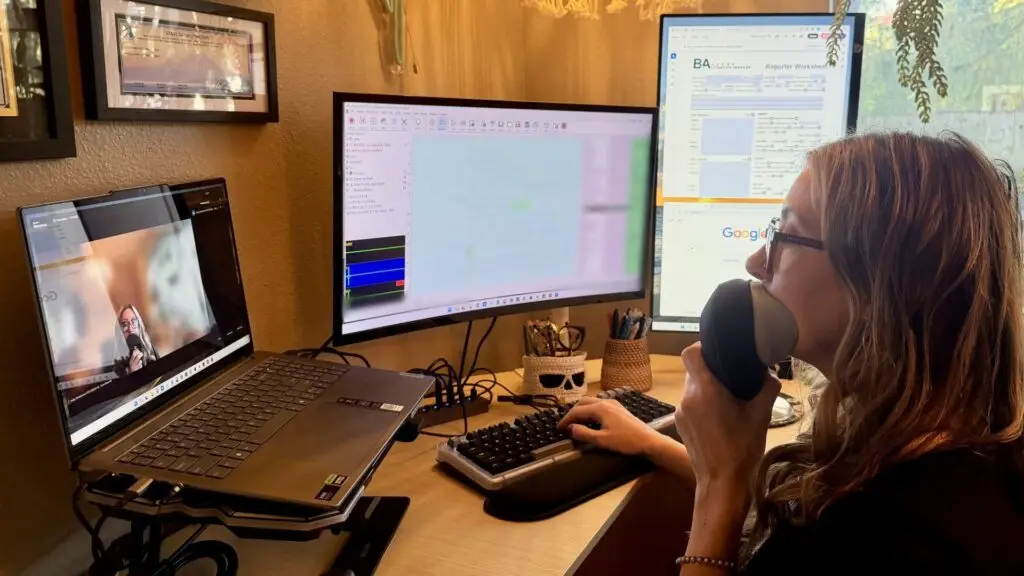
If you’ve attended a deposition recently, you may have noticed something a little different about the court reporter. Instead of using the familiar stenographic machine, the reporter may be speaking quietly into a specialized mask. That reporter is a voice writer.
While the technology may look different, the job is the same: creating an accurate, complete and reliable record of the proceeding. And in Washington State, voice writers and stenographic machine writers are held to the same certification standards to work as certified court reporters.
What Is a Voice Writer?
Voice writing is a method of court reporting in which the reporter repeats the spoken proceedings into a voice silencer, often called a stenomask. The mask is designed to prevent others in the room from hearing the reporter while allowing the reporter’s software to capture and translate their speech.
Much like a stenographic reporter uses a machine and specialized shorthand to capture testimony at high speeds, a voice writer uses trained speech techniques and voice-recognition software to capture that same testimony.
Voice writers don’t simply repeat what they hear. They are trained to identify speakers, capture testimony accurately, dictate punctuation and formatting commands, handle legal and technical terminology, and preserve the complete record of the proceeding.
How Is Voice Writing Different from Machine Writing?
The primary difference is simply how the reporter captures the record.
A stenographic, or machine, writer uses a stenotype machine and writes combinations of sounds, words and phrases using a form of shorthand.
A voice writer captures those same words by speaking them into a mask using voice-writing technology.
They are two different tools for accomplishing the same highly specialized job.
Regardless of the method, the court reporter must listen carefully, distinguish between speakers, capture testimony accurately, handle technical terminology, interrupt when clarification is necessary, manage exhibits and the record, and ultimately produce an accurate transcript.
Are Voice Writers Held to the Same Standards in Washington?
Yes. In Washington State, both voice writers and stenographic machine writers must meet the state’s requirements to become certified court reporters.
Washington law requires a person to obtain a court reporter certificate before representing themselves as a court reporter. The Washington State Department of Licensing recognizes qualifying certification through both the National Court Reporters Association (NCRA) and the National Verbatim Reporters Association (NVRA), in addition to other qualifying pathways.
Most importantly, the method a reporter uses does not create a lower testing standard. Washington’s examination standard requires a court reporter to demonstrate the ability to capture and transcribe two-voice testimony at a minimum of 200 words per minute for five consecutive minutes with at least 95 percent accuracy.
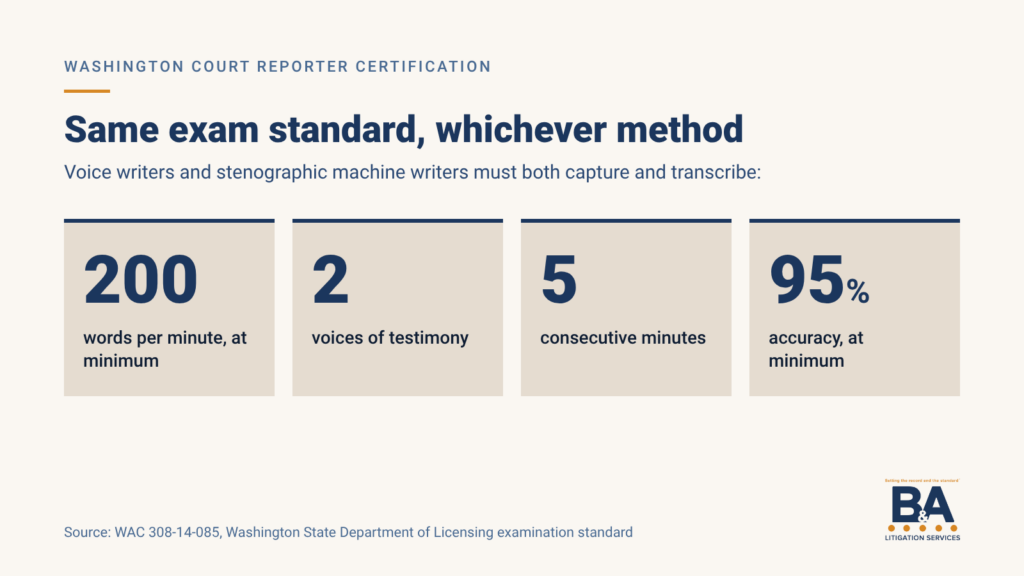
In other words, whether someone becomes a certified court reporter using a stenographic machine or voice-writing technology, Washington requires the same level of demonstrated speed and accuracy.
Once certified, court reporters are also subject to the same Washington professional practice standards, transcript requirements, annual certification renewal and a minimum of five continuing education units every year.
The technology may be different. The certification standard is not.
Does a Voice-Written Transcript Look Different?
No. When you receive the final transcript, you generally wouldn’t be able to tell whether it was produced by a voice writer or a machine writer.
The transcript must still meet the same professional and formatting requirements expected of a Washington certified court reporter.
It contains the same testimony, speaker identifications, exhibits and other required elements of the record, regardless of which method the reporter used to capture the proceeding.
For attorneys, paralegals and other legal professionals, the important question isn’t whether the reporter has a stenographic machine or a voice-writing mask sitting in front of them. It’s whether the reporter can create an accurate, dependable record.
A court reporter should be measured by the quality of their work, not by which piece of equipment they use to create it.
What Is the Mask a Voice Writer Uses?

The mask is probably the most noticeable difference for someone encountering a voice writer for the first time. It allows the reporter to speak quietly without disrupting the deposition or proceeding. The reporter repeats testimony and uses spoken commands for things such as punctuation, speaker identification and formatting. To everyone else in the room, the reporter is largely silent.
Behind the scenes, however, the reporter is continuously capturing the record in much the same way a machine writer is continuously writing on a stenographic machine.
Why Does Voice Writing Matter for the Profession?
The court reporting profession continues to evolve, and voice writing provides another pathway for people to enter the profession and become highly skilled certified court reporters.
For decades, the stenographic machine has been the image most people associate with court reporting. It remains an incredibly sophisticated and effective method of capturing the record.
Voice writing doesn’t replace that tradition. It expands the ways qualified professionals can perform the work. That matters as courts, law firms and litigants continue to rely on skilled reporters to cover depositions, hearings, trials and other proceedings.
More pathways into the profession can help build the next generation of court reporters while maintaining the speed, accuracy and professional standards the legal community expects.
Different Technology. Same Responsibility.
At B&A Litigation Services, we believe a court reporter should be measured by the quality of their work, not by which piece of equipment they use to create it.
Whether our reporter is capturing testimony on a stenographic machine or through voice-writing technology, our expectations are the same: accuracy, professionalism, attention to detail and respect for the record. Washington State expects the same.
Setting the record and the standard.